BLOG: FIELD NOTES
Why Hire a Virtual Assistant from the Philippines? Risks, Reliability and In-House Comparison
Business owners, coaches and employers keep hiring virtual assistants from the Philippines, and the same questions follow: is it risky, are they reliable, and how is it different from an assistant in the office? This guide answers each one with named sources, an in-house cost comparison at fair pay rates, and the risks stated plainly.

FIG. 01: A virtual assistant in the Philippines going through her task list for the day.
QUICK ANSWER
Why do business owners, coaches and employers hire virtual assistants from the Philippines?
They hire for skilled, English-speaking help with repeatable digital work, flexible hours and a lower total cost than a US in-house hire, even at fair pay. The risks are real but manageable: time zones, internet outages, data access and worker classification. Reliability depends on clear scope, fair pay and a paid trial, not on nationality.
Disclosure: I am a virtual assistant based in the Philippines and I sell VA services, so I have a stake in this question. I have worked remotely for US companies for more than 10 years. Every figure below comes from a named source, my own arithmetic is labeled as mine, and the risks get as much space as the benefits.
What makes a Philippine virtual assistant attractive to owners, coaches and employers?
Five reasons come up most often, and each one has a limit worth knowing.
- A deep pool of VAs. Upwork lists the Philippines among the top five countries supplying virtual assistants, alongside India, Nigeria, Pakistan and the United States, according to an AFP report that quotes the Upwork Research Institute.
- English. English is one of the country’s official languages, so most VAs can write client emails, support replies and process notes without a translator (VirtualStaff.ph). Skill still varies, so test writing before you hire.
- A different time zone. The Philippines runs on UTC+8 (MyOutDesk). A VA can clear your inbox, orders or tickets while you sleep, or shift hours to overlap with yours. The limit is that overlap has to be agreed.
- Flexible scope. You can hire for ten hours a week or forty, and for one skill such as order handling or CRM cleanup, without building a full employee package. The steps are in how to hire a virtual assistant in the Philippines.
- Cost, at fair pay. The in-house comparison below uses BLS data for the US side and fair rates for the Philippine side.
The work is mostly digital and repeatable. Common roles are e-commerce order and inventory admin, customer support inbox and ticket replies, and CRM and data admin. Coaches use VAs for scheduling, client onboarding and CRM follow-up. Employers use them to add admin capacity to a team without adding a desk. If you are still deciding, read the signs it is time to hire a virtual assistant, and for the tools side see AI tools for business owners and coaches.
FIG. 02: Tools a VA often works in, grouped by orders and support, and CRM and data.
How does a Philippine virtual assistant differ from an in-house assistant?
The work can be the same. The setup is not. This table compares a US office-based assistant with a Philippines-based VA working remotely.
| Factor | In-house assistant (US) | Philippines-based VA |
|---|---|---|
| Location and hours | On site, in your time zone | Remote, UTC+8. Overlap hours must be agreed |
| How they are engaged | Employee on your payroll | Often a contractor. Classification depends on how the work is done |
| What you pay for | Wages, employer taxes and benefits | The agreed rate, plus 13th month pay if it applies and any tool seats you provide |
| Equipment and workspace | You supply both | Often the VA’s own. Agree who pays for software |
| Oversight | In person | Written scope, shared task board, regular check-ins |
| Legal route | US employment law | Philippine law applies to the worker. Your contract covers the work, and cross-border disputes are harder |
| Coverage when absent | You arrange it | Agree a backup in writing. Some agencies include replacement |
None of these differences is a flaw. They are the terms of the arrangement, and each one needs a line in your plan or contract.
What does each option really cost?
I use BLS figures for the US side and a pay rate I would call fair for the Philippine side. The BLS median wage for secretaries and administrative assistants was $47,460 in May 2024 (BLS Occupational Outlook Handbook). BLS also reports that employer costs for full-time private industry workers averaged $54.00 an hour in June 2026. Wages were $36.97 of that (68.5%) and benefits were $17.03 (31.5%) (BLS Economics Daily).
If I divide the $47,460 wage by the 68.5% wage share, the full employer cost comes to about $69,300 a year. That is my arithmetic. The BLS ratio covers all occupations, so a real offer will differ, and it leaves out recruiting, equipment and office space.
For the Philippine side I use $8 and $12 an hour at 160 hours a month. $8 is the top of the 2026 mid-level range of $6.50 to $8.00 that HireTalent.ph reports. $12 sits just above its senior and specialist range of $8.50 to $11.50 or more, and inside the $10 to $15 range listed for executive assistants in my virtual assistant cost breakdown. I add 13th month pay, one twelfth of annual basic pay, as a fair-pay line even where it may not be legally required.
| Cost line (per year) | US in-house assistant | Philippines VA at $8 an hour | Philippines VA at $12 an hour |
|---|---|---|---|
| Pay | $47,460 | $15,360 | $23,040 |
| Benefits and employer costs, or 13th month pay | About $21,800 | $1,280 | $1,920 |
| Total | About $69,300 | $16,640 | $24,960 |
At these rates the Philippine totals are about 24% and 36% of the US figure. Every number in the table is my calculation from the sources above, not a client result.
Read the gap fairly. The US figure includes health insurance, paid leave, retirement and employer taxes. A contractor VA usually pays for their own benefits, equipment, internet and backup power out of the rate. HireTalent.ph notes that contractors forgo traditional employment benefits and that many employers factor this in when setting rates. That is why I price examples at fair rates and not at the lowest published ones.

FIG. 03: A shop owner packing parcels, the kind of work that eats the day.
Is it risky to hire a virtual assistant from the Philippines?
There are real risks. Most of them apply to any remote hire, and each one has a fix.
| Risk | What it looks like | How to reduce it |
|---|---|---|
| Time zone gap | The Philippines is UTC+8, so US business hours often fall overnight there. | Agree an overlap window, response times and which tasks can run while you sleep. |
| Internet or power outage | Weather and local outages can interrupt a remote worker. | Ask about backup internet and power before you hire, and set a notice rule for downtime. |
| Data security | A VA may see customer records, logins and payment tools. | Use a password manager, two-factor authentication and least access, plus an NDA. Remove access on exit. |
| Misclassification | An employee is treated as a contractor, which can lead to back pay claims. | Review the four-fold test with a Philippine labor lawyer or accountant. |
| Underpayment and turnover | A rate below the market can mean rework and good people leaving. | Pay a rate that matches the skill, and test with a paid trial task. |
| Cross-border recourse | Disputes are hard to enforce across borders, for both sides. | Use a written contract, pay on schedule, and start with a small paid project. |
The risk runs both ways. One person quoted in the AFP report calls VA work risky because no remedy is available if something goes wrong, and a Philippine government spokesperson says one key challenge is that the work is borderless. Paying on a schedule and putting the terms in writing protects both sides.
Is your data safe with a Philippine virtual assistant?
The Philippines has a national privacy law, the Data Privacy Act of 2012 (Republic Act 10173), signed on August 15, 2012 and administered by the National Privacy Commission. A legal overview from Law.Asia says it sets breach notification duties and requires a Data Privacy Officer, and that violations can carry imprisonment, a fine, or both.
That law protects personal information. It does not replace your own controls. A VA with a password can copy or misuse what they can see, in any country. Use a password manager so the VA never sees the password, give access only to the tools the job needs, switch on two-factor authentication, sign an NDA, and remove access the day the work ends.
Is a Philippine virtual assistant an employee or a contractor?
Misclassification is the legal risk owners miss. Philippine courts generally apply the four-fold test: who selects and engages the worker, who pays wages, who can dismiss, and who controls how the work is done. The Supreme Court treats control over the means and methods as the most important element (Supreme Court E-Library). Other tests, including economic dependency on one client, can also apply (ACCRALAW).
A contract that says contractor does not settle it if the daily reality looks like employment. If your VA works set hours, on your tools, under your direction, ask a Philippine labor lawyer or accountant. I am not a lawyer or tax advisor.
Classification also decides 13th month pay. Philippine rules require it for rank-and-file employees by December 24, and the formula is total basic salary earned in the year divided by 12 (P.D. 851, Grant Thornton Philippines). HireTalent.ph notes that contractors are not automatically entitled to it and that some employers offer it anyway. I count it as a mark of a fair arrangement.
Are Filipino virtual assistants reliable?
Many are, and some are not. Reliability belongs to the person and the setup, not the passport. I found no neutral, country-level data on VA reliability, and the claims agencies publish are marketing, so I do not repeat them.
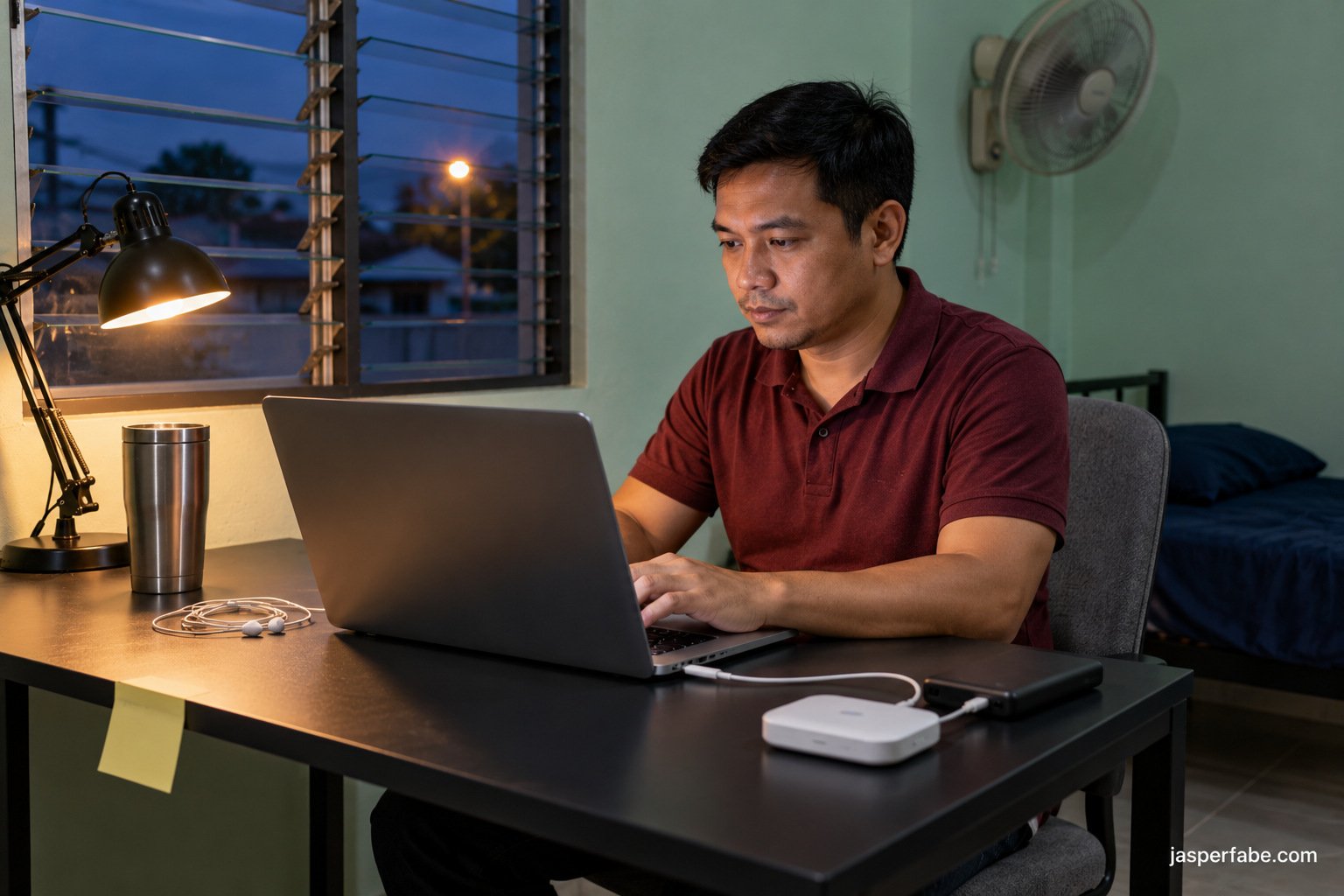
FIG. 04: A backup power bank and pocket Wi-Fi keep a good VA online when the power or internet drops.
What I can offer is what makes a remote worker dependable: a clear scope, a fair rate, written steps, a backup plan and a way to check the work. At Sales Fury, building an automated inventory tracking system and cleaning the underlying records led to 95% fewer data-entry errors and about 40% better data reliability. At Airbnb my work led to 30% faster processing. Those results came from process, not from where I live. To test reliability before you commit, use the paid trial method in the GoHighLevel VA trial task guide. It works for any VA role.
How do you hire a reliable virtual assistant from the Philippines?
Reliability is built before the first task. Follow these steps.
- Write the scope. List the tasks, the tools such as Shopify, Gorgias or HubSpot, the hours and what finished work looks like.
- Set a fair rate. Price the work using current ranges, and remember a contractor pays their own benefits, equipment and backup power.
- Run a paid trial task. Give one to two hours of real work in a test account, then score accuracy, testing and communication.
- Limit access. Use a password manager and two-factor authentication, give only the access the job needs, and sign an NDA.
- Agree hours, overlap and backup. Write down response times, overlap hours, holiday cover and a backup internet plan.
- Put it in writing and classify it. Record scope, pay date, notice period and tool costs, and ask a Philippine labor lawyer or accountant whether the arrangement counts as employment.
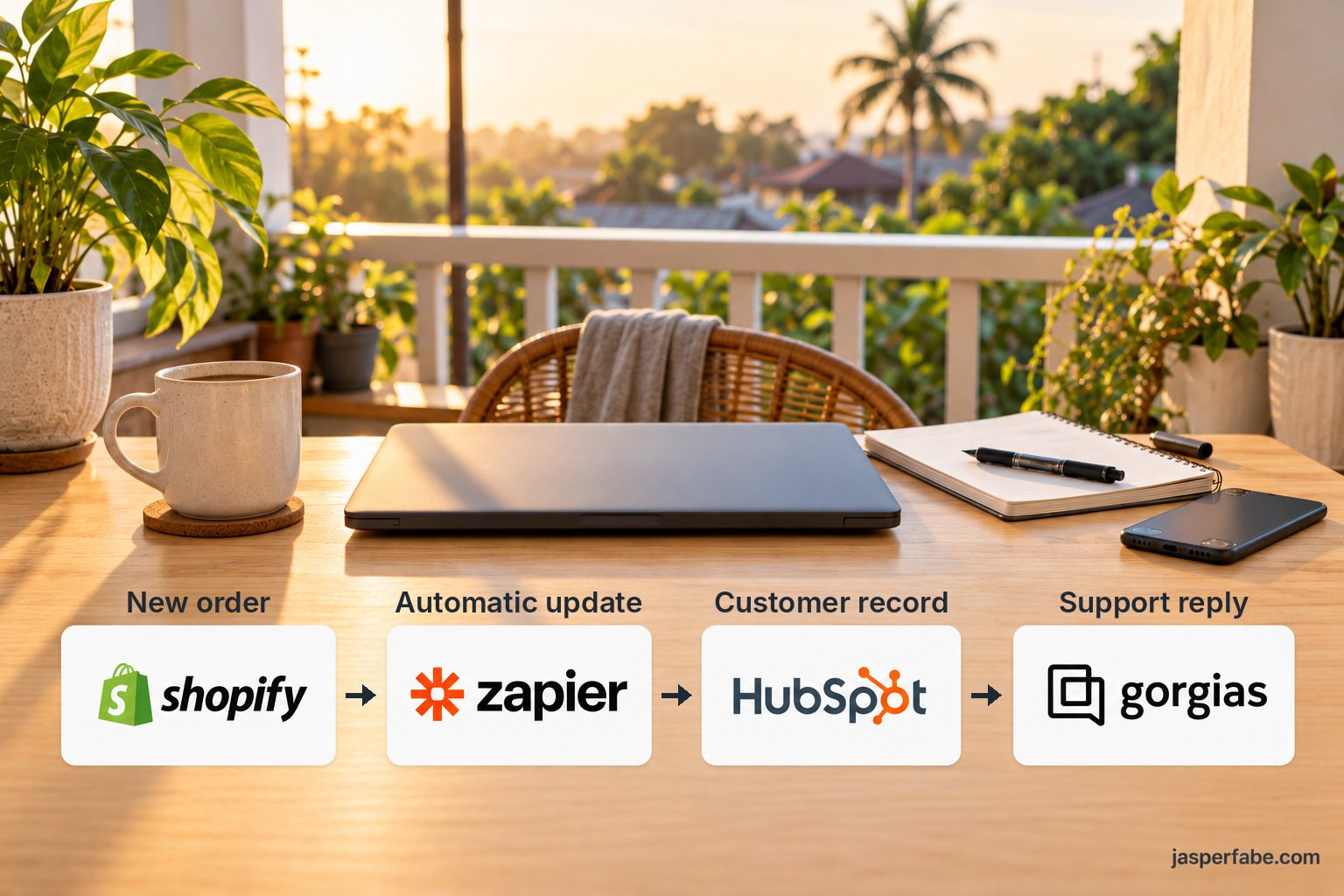
FIG. 05: One workflow from a new order to a support reply.
When is an in-house assistant the better choice?
- The job needs someone present. Mail, deliveries, in-person events and on-site care cannot be done remotely.
- You need the same hours with live handoffs. If you cannot agree an overlap window, a same-time-zone hire is simpler.
- Your contracts or regulations restrict where data is handled. Check this before you give a VA access.
- You want one person under direct supervision. That works, but you carry the full employment cost shown in the table above.
That list is my recommendation, not a rule. If your work is digital and task-based, a VA fits. If part of it is rule-based and repeatable, part of it may suit automation instead, and can AI replace your virtual assistant covers where the line sits. For the full rate ranges and route fees, see the virtual assistant cost breakdown.
Frequently asked questions
Is it risky to hire a virtual assistant from the Philippines?
There are risks, but they are manageable and mostly apply to any remote hire: time zone gaps, internet outages, data access, worker classification and unclear pay terms. Reduce them with a written scope, a paid trial task, limited access, an agreed backup plan and a clear contract. Fair pay also helps you keep good people.
Are Filipino virtual assistants reliable?
Many are, but reliability depends on the individual and the setup, not the country. I found no neutral country-level data, and agency claims are marketing. Check reliability yourself: run a paid trial task, ask for references, agree response times and a backup plan, and write the scope down.
How does a Philippine virtual assistant differ from an in-house assistant?
A VA works remotely in UTC+8, often on their own equipment, and is often engaged as a contractor. An in-house assistant is on site in your time zone and on your payroll. The work can be identical, but the VA arrangement needs agreed overlap hours, remote oversight, a backup plan and a correct classification.
Why do business owners and coaches hire virtual assistants from the Philippines?
They want skilled, English-speaking help for repeatable digital work such as inbox management, scheduling, order admin and CRM follow-up, with flexible hours and a lower total cost than a US hire. The UTC+8 time zone also lets work continue while the owner sleeps, if overlap hours are agreed.
Is my data safe with a Philippine virtual assistant?
The Philippines has the Data Privacy Act of 2012 (RA 10173), which covers personal information, breach notification and penalties. It does not replace your own controls. Use a password manager, limit access to what the job needs, turn on two-factor authentication, sign an NDA, and remove access when the work ends.
How much should I pay a Philippine virtual assistant?
Pay a rate that matches the skill and covers a contractor’s own costs. HireTalent.ph reports 2026 benchmarks of $6.50 to $8.00 an hour for mid-level and $8.50 to $11.50 or more for senior workers. This post uses $8 and $12 an hour as examples. Add 13th month pay if it applies.
Sources
- BLS: Secretaries and Administrative Assistants, Occupational Outlook Handbook
- BLS: Compensation costs for private industry workers, June 2026
- HireTalent.ph: Virtual Assistant Salary in the Philippines 2026
- AFP via Oman Observer: Filipinos see a pathway from poverty with virtual assistant jobs
- VirtualStaff.ph: Why Hire Filipino Virtual Assistants
- MyOutDesk: Virtual Assistants, Philippines vs US
- Wikipedia: National Privacy Commission
- Law.Asia: Overview of Philippine data privacy law and regulations
- Supreme Court of the Philippines E-Library: four-fold test decision
- ACCRALAW: Engaging individual independent contractors in the Philippines
- Labor Law PH: P.D. 851, 13th Month Pay
- Grant Thornton Philippines: 13 things to know about your 13th month
Figures change, so confirm current numbers before you decide. Example calculations are mine and are not client results.
NEED A VIRTUAL ASSISTANT?
Work with a Philippines-based VA who documents the work
I work as a remote operations and e-commerce virtual assistant and I build Zapier and Make automations. At Sales Fury my work led to 95% fewer data-entry errors and about 40% better data reliability.